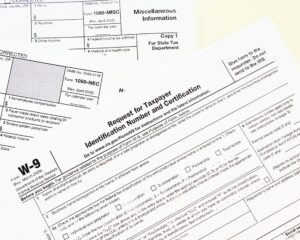
If your business pays independent contractors, W-9s and 1099s are not optional paperwork — they are a legal requirement. And while your accountant can help prepare and file the forms, the responsibility for collecting accurate information and maintaining compliance ultimately falls on you, the business owner.
Here’s what you need to know, why it matters, and how to avoid the most common problems we see every year.
When a 1099 Is Required
IRS rules require businesses to file Form 1099-NEC (Nonemployee Compensation) for each non-employee service provider you pay at least $2,000 during the year. This threshold increases from $600 beginning in 2026.
There are other types of income reported on Form 1099-MISC, but for simplicity, we’ll focus on the most common situation: paying someone for services who is not your employee, typically an independent contractor that needs a 1099-NEC. The issues discussed below, however, apply to all 1099 reporting.
Why the W-9 Is So Important
Before your business can issue a 1099, you must obtain a completed Form W-9 from the service provider.
On the W-9, the service provider provides:
- Legal name and address
- Entity type (individual, LLC, corporation, etc.)
- Federal tax identification number (SSN or EIN)
- Signature and date
Your business uses this information to prepare the 1099 that is filed with the IRS and sent to the service provider. This documentation proves:
- You paid the provider for services
- The payment was a legitimate business expense
- The income should be reported on the provider’s tax return
The burden of proof is on you as the payor, not on your accountant and not on the service provider.
What Happens If You Don’t Issue a Required 1099?
If you cannot demonstrate compliance, you may face:
- IRS penalties
- Disallowed deductions
- Backup withholding obligations
- Increased audit risk
Your accountant cannot fix missing or incorrect information after the fact. That’s why this process must be handled correctly throughout the year, not just at tax time.
Where Problems Commonly Occur — and How to Avoid Them
Issue #1: The Service Provider Refuses to Give You a W-9
This is the most common issue we see.
How to fix it:
Make W-9 collection part of your standard process. Before you engage a service provider or issue any payment, require a completed W-9. Email it, include it in your onboarding packet, or make it a condition of payment.
Issue #2: “I Don’t Need to Give You a W-9 — I’m Incorporated”
Under IRS rules, businesses that are true corporations (typically with “Inc.” in their legal name) generally do not require a 1099. That’s because corporations are subject to their own reporting and compliance requirements.
However, this is where confusion often arises — especially with LLCs.
Many service providers operate as Limited Liability Companies (LLCs) and assume that means they are treated as corporations for tax purposes. An LLC is a legal structure, not a tax classification. LLCs can be taxed as:
- A sole proprietor
- A partnership
- An S-Corporation
- A C-Corporation
Unless the LLC has formally elected to be taxed as a corporation, it may still require a 1099. Simply having “LLC” in the business name does not automatically exempt the provider from 1099 reporting. Get a W-9 from all LLC’s for this reason.
Some providers may claim they are incorporated when they are not.
How to fix it:
Do not rely on verbal assurances. Verify the entity. Get a W-9 from all LLC’s.
For businesses that claim they are “incorporated”, you can confirm whether a business is actually incorporated by:
- Searching the Secretary of State website where the business is registered
If the business does not appear as a corporation, meaning they don’t have “Inc.” at the end of their name, require a W-9. The W-9 determines 1099 requirements — not assumptions or statements made by the service provider.
Issue #3: Incorrect Taxpayer Identification Number on the W-9
Sometimes a service provider provides an incorrect Social Security Number or EIN, either by mistake or intentionally. When this happens, the IRS will send you a notice stating that the payee information on the 1099 does not match their records.
At that point, you have three options:
- Request a corrected W-9
If the error was accidental, update your records and use the corrected information going forward. - Initiate IRS backup withholding procedures
If the provider refuses to provide corrected information or continues submitting incorrect data, IRS rules require you to withhold 24% of future payments and remit it to the IRS on their behalf until the issue is resolved. - Stop working with the service provider
If the provider refuses to comply, discontinue the relationship. This protects your business from future penalties and from owing tax on someone else’s income.
Final Thoughts
The IRS provides blank W-9 forms on its website, and collecting them is simple — but only if you make it part of your normal business process.
We know paperwork isn’t why you started your business. However, requiring a W-9 before paying or fully engaging any service provider will save you time, money, and stress in the long run.
As a full-service accounting firm, we’re here to guide you — but compliance starts with good procedures inside your business.